Tuesday, March 30, 2010

Month 5: Data Structures, Flash Workshop and Ethics and Psychology

I just finished my fifth month at Full Sail. The classes are getting tougher but the material is also becoming more interesting. The drive to learn is pushing me farther along and making me enjoy the work that much more. I took a flash workshop on Sundays taught by Mike Arlington. He challenged us to make our own game by the end of the month and I am proud to say that I have finished the mechanics for mine (However, I am no artist and am in need of some better assets). He also taught us how to but our games online and make money off them.

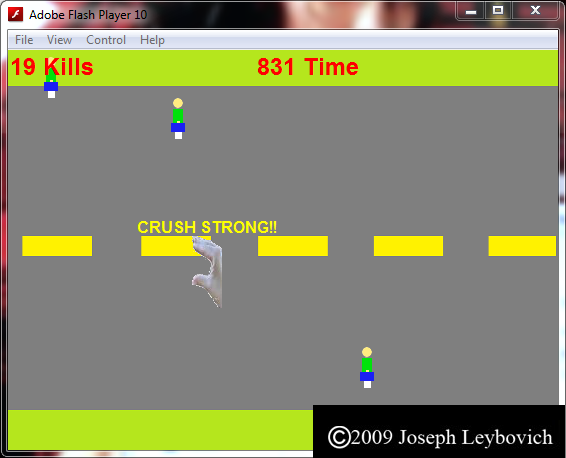
I Crush Ur Head - This is my flash game where the player must click on the head of pedestrians in order to crush their heads. (inspired from the Kids In The Hall skit)

Rodney taught us data structures. He is a very cool guy who went through the course when he was younger. He gave hard tests that really pushed us to know the material. We would have to know how to draw the data structures and how all their operations functioned. Rodney kept us laughing throughout the month and gave us projects such as Simon and Boggle.

Lance “Doc” Percy taught us psychology. He told us that it could help us in three areas, character development, industry communication/marketing, and self-improvement. We learned about the three schools of western psychology. We also had to incorporate the theories we learned into characters as part of a story we wrote in groups. We took different kinds of personality tests and learned a lot about ourselves. We also discussed many movie and game characters as well as watched some funny, interesting videos.

Saturday, March 20, 2010

Johnny Cupcakes

This past week I had the pleasure of attending a lecture by Johnny Cupcakes, at Full Sail Live. It was a great experience to hear his story and tips for running a business. Johnny said that there are different ways of thinking and making money but he always went with his gut and took lots of risks to bring him success. He also discussed many of his struggles and things he wished he had known when he was growing his business.

Johnny always wanted to do things himself, but soon found out that delegating tasks was an important part of growing with your business. He mentioned that going into business with friends was not always a good ides. He emphasized that “to make money, you have to spend money” and the more detail you put into the little things the more you build an experience that your clients will remember.

Johnny also emphasized the importance of first impressions, spending your time wisely (giving yourself extra time if needed), appealing to a wide audience, keeping your employees happy, ensuring your products longevity, location and utilizing your community (keeping it personal) and the Internet. We watched his webisodes off johhnycupcakes.com about the development and events at his stores. He mentioned that he has been able to keep people interested in his brand by making limited edition items and not selling out to large corporations. He exclaimed “people like what they can’t have” or what nobody has.

Johnny has done many promotions such as contests and sales. He has taken many risks, put work before play and has taken the not so common path but it has worked out for him greatly. He always wanted his customers to relive the past through his shirts and style. He loves what he does and will continue to grow his businesses. I have learned a lot and had a great time at the lecture, at the end he gave out prizes to students who could answer questions about old Nickelodeon shows.

Saturday, February 27, 2010

Month 4: Physics and Programming 3

I just finished my forth month at Full Sail. Half my class from last month did not pass those classes so my class for physics was about half in size, and there were some new faces in programming 3 those who took it last month and did not pass. As the work gets tougher it becomes harder to keep your grade at the point where you want it, however with increased studying, in office hours, before class with classmates or by one's self, the work does not seem unmanageable. And of course it helps if you love what you are learning.

We had Mr. Bahin again for physics and he still kept us laughing even though many students were falling asleep in his class due to the fact that the nights before we had class until 1am and had to be in his class by 9am (that's Full Sail for you). He taught us well and did not overload us with work. We had many simulations to program which included friction, gravity and collisions. The lab assistants were very helpful as usual.

For programming 3 we had Arthur Johnson, a very enthusiastic man who taught at UCF (University of Central Florida). He taught us a lot about what to do on interviews and how to be an efficient programmer during different situations. Everyday a question box would pop up, randomly, on the projector with a random student's name and generate a question based on the topics we covered the class before. If the student would get the question wrong they would lose ten GPS (Global Professionalism Standard) points. After the question, which were pretty difficult if the student did not study, the generator would produce a movie/game trivia question to lighten the mood back up. Each lad in PG3 would be based somewhat on the lab before that. This means that through the whole month we made a simple tank game and learned all the different implementations of what we could put in a game from cheat flags to sound to cell based images and even high score displays. Also if you are going into PG3 be ready to learn a lot about file input/output.

Monday, February 1, 2010

Month 3: Linear Algebra, Programming 2 and my first Global Game Jam

In linear algebra we learned the basics of how math applies to programming in games. We had to make transformation simulations, among others, and our own vector and matrix math functions library. The lab assistants were very helpful as usual. Our professor, Richard Bahin, was very knowledgeable and always made the class fun and interesting giving us real world examples and telling us what we need to know when we apply for industry jobs.

Programming 2 was more complicated than programming 1 but we learned a lot more about classes and dynamic memory. Our professor, Justin Tackett, would give us assignments to make programs that one would find in games. We always had a great time coming up with hilarious spells for Wizard characters like "Summon Beans" and the such. The lab techs were awesome as well.

In my first Global Game Jam I worked with a team of 7 other people, from artists to programmer to producers and designers, to make a game in 48 hours. Our team "Lost Sheep" worked very hard for the duration of the jam everyone got along with each other and we were able to produce an awseome, working game in the end, "Shogun's Shadow". It is a side scrolling 2 player platformer were the goal is to be the first ninja to kill the shogun by avoiding the lights and decapatating him.


Friday, January 15, 2010

Otronicon 2010

I just came back from my first gaming/technology convention, Otronicon at the Orlando Science Center. After killing some zombies in Left 4 Dead in the LAN room, my friends and I got to experience the birth of videogames by playing Pong on a genuine Atari 2600.

Next, we went to the second level. The first exhibit we saw was the Evolution of the Mac. They had old Macintosh computers all lined up on a shelf. We also saw a dancing fountain that made water dance to music. We even got to meet the programmer.

Afterwards, we jammed out at the Rock Band Experience. An auditorium set up with stage and Rock Band equipment. The game was projected on a large screen behind the band; each player had his or her own monitor, as well. The game had many songs to choose from, our band, The Grim Pirates, did In Bloom by Nirvana.

There were many flight simulations from helicopters to jets with realistic cockpits and controls.


There were driving simulations as well. PHENIX Design Group, Inc made one were they actually used a real Scion V8 and put in a seat that would simulate driving more realistically with movement. Another one was made by Full Sail it was called Stunt Racer. This simulation would let the player drive ridiculously fast, make insane jumps and drive up walls while still reacting like a real car.

 Lockheed Martin had some touch screen tables with games like Simon Says and Tick-Tak-Toe as well as a cool robotics team game controlled from computers. Google Earth also had a cool table to look anywhere in the world.

There was also Medical Sim City, which had the latest in medical technology for training surgeons and nurses. Such as the da Vinci machine, a stitching trainer, a simulated patient and wireless conferencing for doctors during procedures.
 
The military was also present to show off their training simulations. These included M-16s with air cartridges to make realistic recoil, a game that lets you pilot any military vehicle in a virtual world and a robot that could be controlled with a Wii-Remote.

Other cool exhibits included a giant chessboard, a painting simulation which was pretty close to the real thing and of course a costume contest which means you will find a storm trooper.

 The third floor had the Artronica Gallery which had a lot of nice art made by students at Full Sail including character sculptures. One artist showed us how he made his work in Maya. Inspired we signed up for a 3D animation workshop and got to play around with some pretty cool characters.


The forth floor had some older games and also had the best new games available. There were tournaments in games like Super Smash Bros. They had the new Super Mario Bros for the Wii as well as Call of Duty: Modern Warfare 2, Uncharted 2: Among Theives, and Tekken 6. We ended our day with on online interview with some game developers at Armor Game. They told us valuable information on what it takes to make a great flash game and how to deal with crazy schedules in the industry.


Overall I had a great day and I owe it to Full Sail  for giving me the day off of school to check our their event. It was an awesome experience and I cannot wait to go to more conventions. I learned a lot today, but one thing for certain, if their is a will and a need for the technology, no matter what that need is, there will be someone solving the problem and coming up with creative and innovative solutions. 
Sunday, January 3, 2010

Month 2: Calculus, Trig, Programming 1 and My 1st Game Jam

I have just completed my second month at Full Sail University during which I had two classes, Calculus & Trigonometry which was instructed by Shane Saeidi, and Programming 1 instructed by Doug Monroe. Both classes required us to learn a lot about a complex subject in a crammed amount of time, especially because it was December, when everyone gets a two week vacation (longest break you get at Full Sail) at the end of the month so the workload was even more jammed.

Doug and Shane both were excellent in their jobs to teach us the material. Doug found ways to help us relate to the tedious fundamentals of C++, and Shane would teach us the important parts of Calculus while making us feel smart enough to keep up with all the work. In the end both instructors made some of the dullest subjects fun and easy to learn. Whenever someone did not understand, help was offered not just from the instructors but from other students, who were more familiar with the subjects, outside of class.

After a four-hour lecture during the day we would spend another four hours in lab working hard at night. In Calculus we would just do problem after problems the lab work would turn to homework if you did not finish it, which was usually the case seeing as you have around seventy-five questions to get through.  In programming we would write programs that would teach us the principles. The lab assistants in both subjects were knowledgeable and friendly. They would help our brain understand when we thought it was already full to the max.

As if the forty-hour weeks (and one fifty-hour week) were not enough for me I took it upon myself to join the 24-hour Game Jam at Full Sail. On one Saturday around 8 programmers from different months in the program were trapped in a building and had to create a game in 24 hours. I was a great experience, no sleep just work. It really made us prove ourselves. We all just were coding, designing and eating cold pizza and stale donuts all day. The guys I met and worked with all had great attitudes and wanted to do their best when it came down to work.

Hitting milestones every few hours was difficult and when problems stopped the whole production we were left sitting waiting to get back to work. It really felt like I was working for a game company everyone was professional, but humorous as well, and we all felt like we were contributing to something we all thought would be fun. I defiantly will be signing up again.

Monday, December 28, 2009

Roads and Video Games

Roads and video games are two very different things with very different purposes. Video games let us play in a different world and roads get us from one place to another in the real one. However in this essay I will look at one aspect in which I believe they are very similar, design.

Both roads and video games need a thoroughly planned out blueprint for how they will be made. Dealing with roads these are quite literal blueprints, in video games these come in the form of design documents. During the building process these blueprints need to be split up and distributed to the team. If a plan cannot be met, due to regulations, guidelines or just harsh reality, the design must change, whether you are dealing with cement and metal or code ad pixels.

The type and purpose of roads and video games play an important role in their design. Is it a street? Highway? Freeway? Is it a platformer? Shooter? RPG? What is the goal? Should the player/driver have a lot of choices? Are there a lot of traffic lights? Are left turns or u-turns allowed?  Can the player jump? Is it as simple as a straight racetrack with one purpose and no speed limit or as complex as streets in a big city? The streets in GTA4 are unique because they use actual street designs from New York to create the free roaming feel of the game and relate the player/driver to the map.

There are other factors that should be considered in design. For roads the sizes of the vehicles that will be driving on it are important, height/weight limitations, size of lanes, bridges and tunnels with games the size of the characters and other objects relate greatly with the overall goal and efficiently. Thinking of the paths and destinations of the player/driver is crucial, how will they get there? How long will it take them (average playtime)? How far do they travel? Is there parking (save points)? How many?

The results of the design decisions made will relate directly to the efficiency and popularity of the roads/games. If the roads are hard to navigate the driver cannot make it to their destinations, they will become frustrated, similar to having bad camera controls in a game, and have to take out their anger by playing a game like Road Rash or Burnout. However if the choices were thought out and implemented successfully then when the driver is cruising down the street they do not realize that they are driving, similar to how a great game submerges the player into the game.